



i
Join the status waitlist
No charge, no checkout. Tell us which peptides you're watching and where to reach you.
We won't pretend they're for sale. Here's the honest status of the two recovery peptides everyone asks about: what each does, how they're paired, and a notify-me for the moment either is legitimately available.

The same two-signal status you'll find on our live FDA Tracker. On July 23, 2026 the advisory panel recommended both for the 503A list, a recommendation, not approval or availability, so both are still 🟡 waitlist today.
Plain English: being recommended by an advisory panel is not the same as being legal to compound, and neither is the same as being available to buy. On July 23, 2026 both were recommended for the 503A list, FDA rulemaking must still follow. We track each and update it as the agency acts, and we will not sell what we can't stand behind.
★ Get the status the moment FDA rulemaking moves. Free, no card.
They're different peptides, almost always discussed together: the pairing the internet nicknamed the “Wolverine stack.” Here's what each is for, the honest evidence on both, and why pairing them doesn't double the proof.
Both were recommended by the FDA's advisory committee on July 23, 2026 for the 503A compounding list — a recommendation, not approval or availability. Both remain waitlist/education-only here. The vote does not upgrade the evidence: both are still grade D.
A 15-amino-acid peptide derived from a protein found in gastric juice. Taken in hope of supporting tendon, joint, muscle, and gut-lining recovery: the most-discussed of the recovery peptides.
Animal-dominant data with high interest. The marketing is far louder than the human evidence, which is thin.
Evidence grade D: fewer than 30 humans studied, no placebo-controlled efficacy trials. WADA-banned (S0).
A synthetic 7-amino-acid fragment related to thymosin beta-4 (Tβ4). Discussed for soft-tissue and tendon recovery, almost always alongside BPC-157.
Even earlier than BPC-157 on human data, and the marketed fragment differs from trial-grade thymosin beta-4.
Evidence grade D, plus an immunogenicity question: antibody responses have been raised for the fragment. WADA-banned (S0). The marketed fragment isn't trial-grade Tβ4.
The theory is complementary: BPC-157 for the gut-and-soft-tissue angle, TB-500 for soft-tissue repair, and both sit under the same FDA review. If and when both become legitimately available, we'd expect to offer them as a paired recovery approach. But be clear-eyed: pairing two grade-D peptides doesn't double the evidence.
The pairing people call the “Wolverine stack”, sorted honestly. Go deeper in the Knowledge Base, or check both peptides live on the FDA Tracker.
Each routes to its honest status page and a waitlist, never a checkout. Browse to the one that fits.
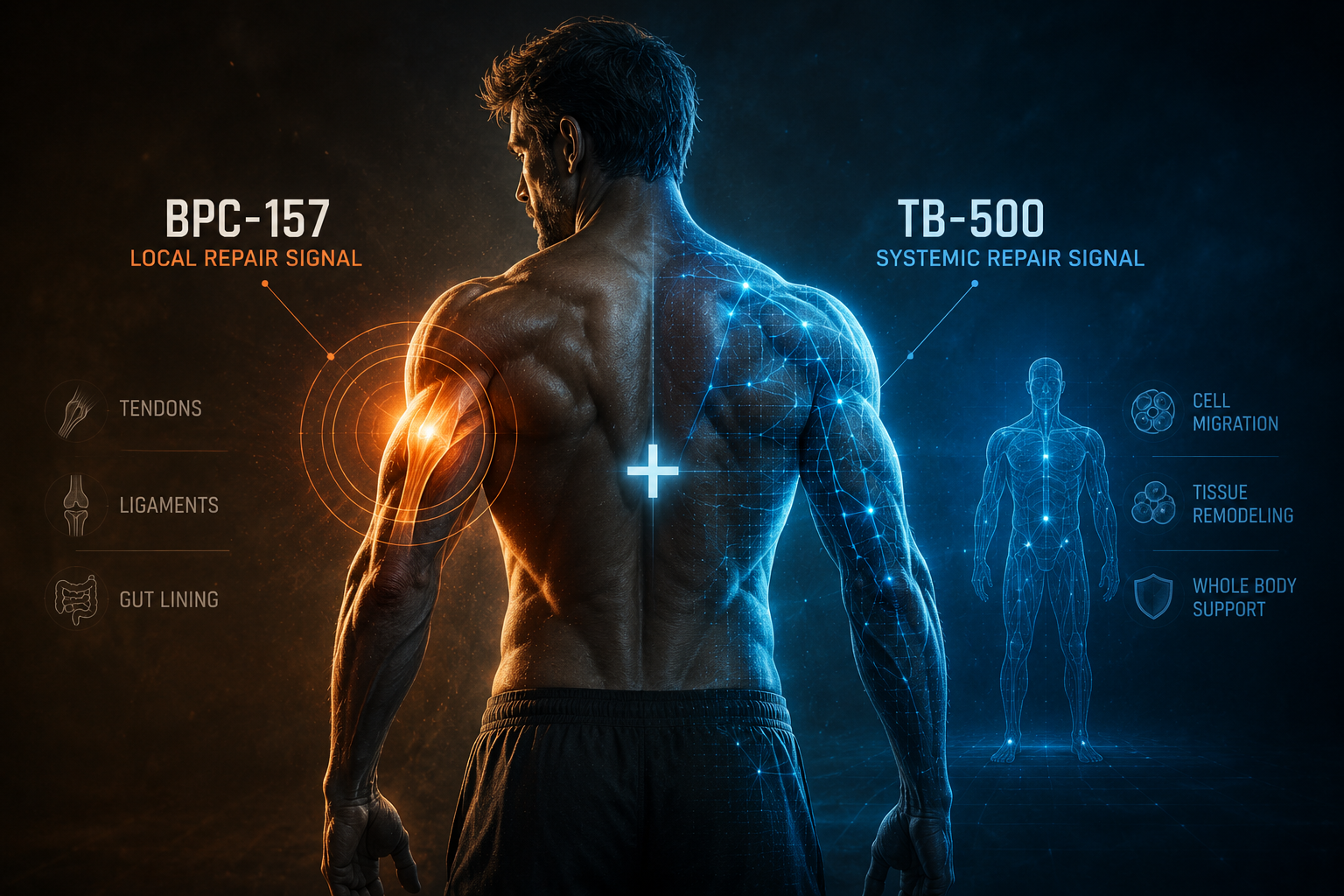
BPC-157 as the local repair signal, TB-500 as the systemic one, the pair people call “Wolverine.” See the honest status of both and claim your spot at the front of the line.
You've seen BPC-157 everywhere and want the real regulatory status, not the hype.
You already know BPC-157 and want the peptide it's usually paired with for soft-tissue recovery.
You've got a nagging injury that won't settle and want the honest recovery-peptide landscape.
Gut issues nobody's solved, and you want the BPC-157 and KPV conversation, told straight.
Everyone else is racing to sell these the moment a headline drops. We're doing the opposite, and it's not charity. Being the operator who tells you exactly where it stands is how we earn the relationship.
We publish the actual regulatory status of each peptide: the two-signal pill and the plain-English verdict, updated as the FDA acts.
If it's under review and not legitimately available, we say so. No prices, no “buy now,” no availability promises we can't keep.
Join the waitlist and you hear first: the moment it's legitimately available through a licensed pharmacy, before any public launch.
Recovery is episodic: you come in for one injury and heal. So the honest move is also the smart one: we set you up in a longevity protocol that's actually available now, so you're cared for between catalysts instead of churning.
Seven peptides are under FDA review, none has been reclassified. The July 23–24 meeting is advisory; a favorable vote starts a process that takes well into 2027. We'll tell you exactly where each one stands, and notify you the moment anything legitimately changes.
The peptide therapeutics market is projected to grow from roughly $141B (2025) to $295B by 2033. (Grand View Research, 2026)
Most peptides online ship under a “research use only: not for human consumption” label. That one phrase lets a seller skip FDA oversight, sterility testing, and any real manufacturing standard, and hands the entire risk to you.
Prescribed by a US-licensed clinician. Compounded in a US-licensed 503A/503B pharmacy to USP sterility and potency standards. Third-party tested every batch: identity, potency, and sterility. Monitored as an actual clinical relationship, not a one-time sale.
Compounded medications are not FDA-approved. Where that applies, we say so. Status and timelines are tracked openly on our FDA Tracker.
See exactly where every compound standsPowered by a clinical network that supports 3M+ patients a year and 20,000+ licensed clinicians across all 50 states.
No charge, no checkout. Tell us which peptides you're watching and where to reach you.
We publish the real status on the live Tracker and email plain-English updates as the PCAC review proceeds.
Only if and when the review concludes favorably and fulfillment through a licensed pharmacy is confirmed. Waitlist members are notified before any public launch.
Hubs link across to the Knowledge Base, out to the live FDA status, and into the longevity protocol that's available today.
Join the status waitlist. We'll notify you the moment these recovery peptides are legitimately available, and keep you posted on the FDA review in plain English. After the July review we'll email you the outcome in plain English, favorable or not, plus your spot if anything becomes available.